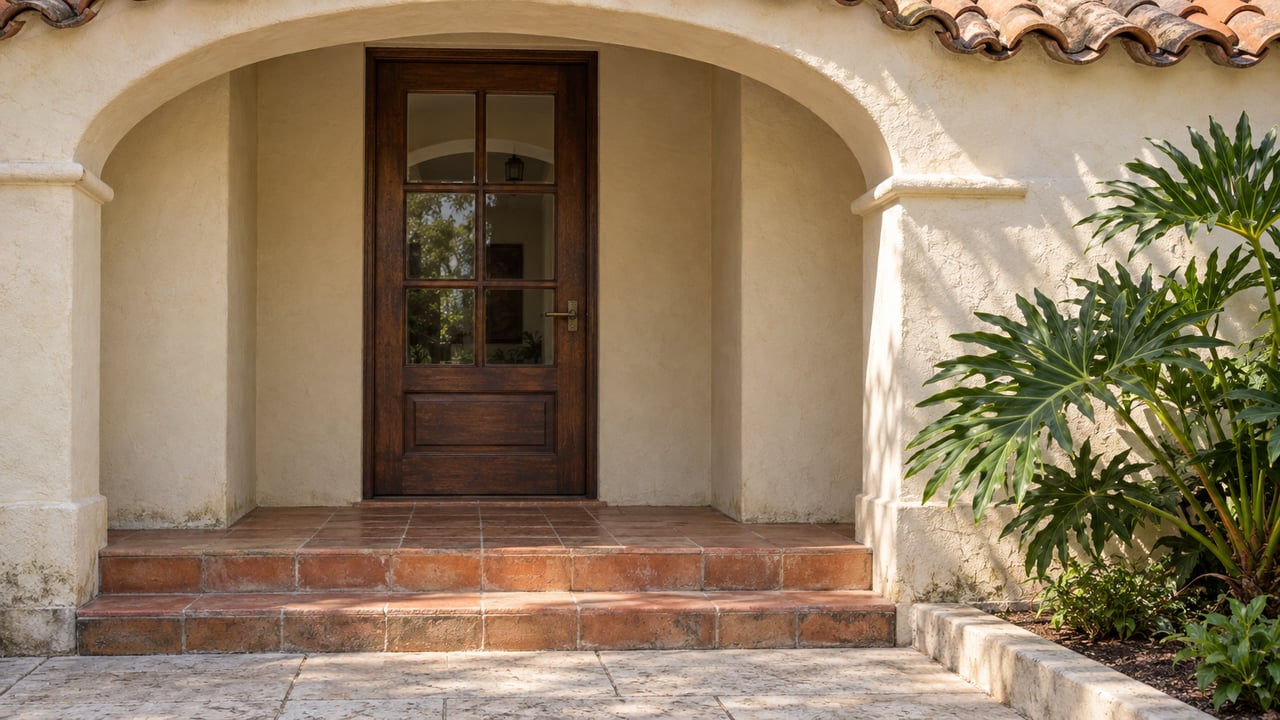
Coral Gables now reviews many routine single-family permits on the same day they come in. That covers a new roof, impact windows, exterior paint or a modest kitchen refresh. The City of Coral Gables reported on September 24, 2026 that its Same Day Permit Program is a no-cost pilot. Applications submitted with fees paid before 8 a.m. get same-day review, and later submissions are reviewed by the end of the next business day. The same release lists who is excluded. That includes work on historic properties, properties inside historic districts, projects using private providers, anything needing structural or mechanical review, and sub-permits filed under a master permit.
For a buyer, that one exclusion changes how you compare houses. If you plan to renovate after closing, a 1920s home in one of the Gables' historic villages and a newer house a few blocks away are on different permitting tracks, even at the same price. The slower track is more work, but it also comes with a tax benefit the fast track doesn't offer.
Which lane a house lands in
The program is limited to smaller residential work that does not require structural or mechanical review. Within that range of routine jobs, designation decides whether the same project qualifies. Here is how the same projects compare across the two tracks, based on the September release and the city's historic preservation guide.
| Project | Non-historic single-family home | Designated landmark or home in a historic district |
|---|---|---|
| Re-roofing | Eligible for same-day review | Certificate of Appropriateness required; staff can handle it as minor work |
| Exterior painting | Eligible for same-day review | Certificate of Appropriateness; staff-level minor work |
| Doors and windows | Eligible for same-day review | Certificate of Appropriateness; changes to openings can reach the Historic Preservation Board |
| Certain kitchen and bath work | Eligible unless it involves HVAC or vented range hoods | Excluded from the program |
| Additions, demolition, major exterior remodel | Outside the program because structural review applies | Public hearing before the Historic Preservation Board |
The guide sorts work by impact. Re-roofing, painting and in-kind repairs count as "minor" and may be handled administratively by staff. Additions, demolitions and major exterior remodels count as "substantial" and are scheduled for a public hearing. Windows sit in a gray area. A 2026 Historic Preservation Board agenda included a Special Certificate of Appropriateness request to enclose a historic-district home's open porch with impact-resistant windows and doors. The city guide does not spell out whether a like-for-like window swap stays with staff. Treat that as a question for Historical Resources staff, not an assumption.
What the fast lane has actually delivered
In its first month the program processed 158 qualifying applications and completed 295 individual discipline reviews. It approved 65 applications and issued 52 permits. So fewer than half of the applications reviewed quickly were approved in that first month. The city says plainly that same-day review does not guarantee approval, and applications needing corrections must be updated first. Once every discipline signs off and the remaining fees are paid that day, the permit is issued automatically that evening.
The program builds on a permitting office that was already doing better than its reputation. In February 2026, the Coral Gables Gazette reported on an assessment by JRD & Associates. It found an average first review cycle of just under six days, 81% of plans reviewed within two cycles, and nearly 70% of permits issued within four weeks. The same report said 94% of permit activity was for projects under $100,000. City officials also told the Gazette they had hired nine more reviewers and inspectors. Routine, low-cost work is the bulk of what the city handles, and the fast lane is aimed right at it. Historic homes are the main group of single-family houses left out.
The slower lane has two boards
The Board of Architects reviews every Gables house, historic or not. The city says it meets every Thursday and reviews new residences, pools, pavement, roof tiles and building expansions. A typical building permit needs preliminary and final Board approval before it is issued. Applications are due by noon the Friday before the Thursday meeting. Metal roofs on single-family homes, both new roofs and re-roofs, require Board review, plus a physical panel sample and a chosen color. Exterior painting goes through paint color review, and the city links pre-approved Benjamin Moore and Sherwin-Williams palettes.
Historic homes add a second layer. A Board of Architects recommendation has to come before a Certificate of Appropriateness submission, and the Historic Preservation Board's deadline calendar shows one meeting a month. The application calls for a full set of drawings, requires the applicant or a representative to attend the hearing, and allows an appeal to the City Commission within 10 days of a Board ruling. Review follows the Secretary of the Interior's rehabilitation standards. Deteriorated historic features should generally be repaired, and replacements should match the original's design, color, texture and, where possible, materials.
The city posts no guaranteed end-to-end timeline for this process. As a planning estimate, allow roughly one monthly meeting cycle after a complete application makes the cutoff for hearing-level work. A missed deadline, a deferral or a round of revisions can add more.
Where this applies on the map
The city's district maps and village descriptions list these residential historic districts and areas:
- The villages: Chinese Village, Dutch South African Village, Florida Pioneer Village, French City Village, French Country Village, French Normandy Village and Italian Village
- Street districts: Alcazar Avenue, Alhambra Circle, Campina Court, Castile Avenue/Plaza, Coral Way, Obispo Avenue, Santa Maria Street and Santiago Street
- Subdivision: MacFarlane Homestead Subdivision, which the city notes is its only historic district listed in the National Register
The categories overlap. The five homes listed in Florida Pioneer Village also sit inside the Santa Maria Street Historic District. Individual landmarks can stand anywhere. The city's register of locally designated properties is an address list marked "Through 07-16-26," and it includes several Country Club Prado addresses. The city's GIS layer also separates contributing, non-contributing and landmark classifications. Ask how a specific address is classified, not just whether it falls inside a district boundary.
The tax exemption that offsets the wait
Designation adds steps, and it also adds a tax benefit. Owners of properties on the Coral Gables Register or the National Register, whether listed individually or as contributing to a district, can apply for an ad valorem tax exemption tied to rehabilitation. Miami-Dade County describes the exemption as applying to the added value from qualifying improvements, not as a freeze on the whole property. The county's own benefit covers its operating portion of taxes for 10 years.
Timing is what catches people out. The county requires Part I before construction, with "before" documentation and proof of designation. Part II comes after construction, with after-photos and a signed covenant. The county's instructions also say a separate municipal filing is needed to claim a participating city's share, and they list Coral Gables among those cities. The Coral Gables form also requires Part I before construction and Part II after construction. Review then goes to the Historic Preservation Board and the City Commission, and a covenant binds the owner to maintain the qualifying improvements for the exemption term. If you start work before filing Part I, you cannot recover that step afterward. Confirm with your tax advisor whether the exemption fits your plans.
A survey to watch in the Flagler Section
The map may change. The city commissioned a draft North Ponce & Flagler Section Historic Property Survey that inventories 556 historic resources across both areas. The Coral Gables Gazette reported in August 2026 that it was expected to go before the Historic Preservation Board and the City Commission this fall. According to the draft, the Flagler Section was first planned as a business district and became a mostly single-family neighborhood in the 1940s. At the September 17, 2026 Historic Preservation Board meeting, staff said they were still coordinating the consultant's presentation and stressed that the document is a survey, not a designation report. Published coverage doesn't split the 556 resources between the two neighborhoods, so no Flagler Section house should be assumed eligible yet. The next City Commission meeting is October 13 and the next Historic Preservation Board meeting is October 15.
Checking status before you make an offer
The window to do this is short. In August 2026, MIAMI REALTORS' screen of million-dollar single-family submarkets put Coral Gables at a $2.2 million median sale price, with 141 active listings, four months of supply and 24 median days to contract. That's a snapshot of the luxury segment, not every Gables home, but it means the time between seeing a house and committing to it can be measured in days.
- Look up the address in the city's Coral Gables Online GIS portal under historic districts and properties.
- Check it against the register of locally designated properties.
- Email Historical Resources staff at [email protected] for a formal determination, and ask whether the house is contributing.
- List your first-year projects and sort each one into staff-level, hearing-level or Board of Architects-only work before you set your move-in date.
- If the house is designated, plan the Part I tax exemption filings into your contractor schedule from the start.
FAQ
Does a home in a historic district need approval just to repaint? Painting is listed as minor work that staff may approve administratively under a Certificate of Appropriateness. Historic homes are still excluded from same-day review.
Can a non-historic home lose its spot in the fast lane? Yes. An application can be removed from the program if a Board of Architects reviewer decides it cannot be approved administratively.
Can anyone nominate a property for designation? The city's guide says any person with specific information about a property's significance may nominate it, and the Historic Preservation Board has final authority.
If you're weighing a historic village home against a newer house nearby and want to know how each one's status affects your renovation timeline and tax planning before you make an offer, Pam Mayers and The Mayers Group can help you sort that out early. Let's Connect: Schedule a Consultation.
