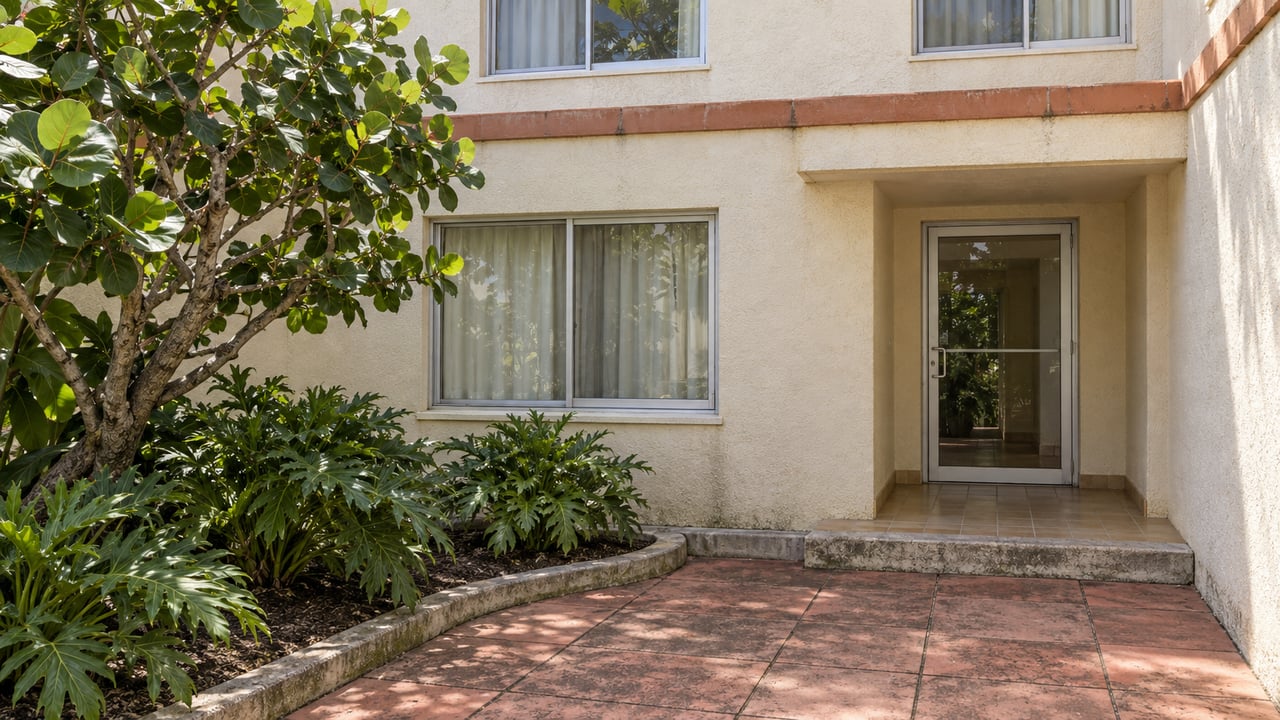
By early 2026, seven unit owners at Bayshore Park, a 39-unit 1960s building at 2545 South Bayshore Drive across from Monty's Coconut Grove and the marina, were the only ones left who hadn't sold. The 32 neighbors who sold the summer before had received an average of $661,843 per unit. The Real Deal reported that in March 2026, BH Group and Mast Capital paid the remaining seven an average of $985,714 each.
That gap of nearly $324,000 per unit came from the same building, the same buyer, and units the seven had bought in the early 2000s for an average of about $100,000. If you're comparing older Grove condos, these buildings carry two prices at once. One is what the unit is worth as a home. The other is what the land under it is worth to a developer, and Florida's termination statute decides who collects that second price and when.
A list price reflects only the first value
On the portals, the Grove's lower end looks soft. In an October 7, 2026 article, Miami Today quoted Mint Developers CEO Daniel Berman describing "two speed markets racing at the same time." He said the older end is "a buyer's market" where "it's taking longer to sell the properties," while new construction stays scarce. The same article cites a David Siddons Group forecast of fewer than 400 new condo units entering the Grove between 2026 and 2028.
That scarcity is why developers are buying older buildings. Coconut Grove Spotlight quoted Spencer Morris of Allen Morris Company, the developer of Ziggurat on Grand Avenue: "the land values have surpassed the improvement values of the existing buildings." The Spotlight also tied part of the pressure to the Florida Building Safety Act, which raised reserve requirements and required more frequent structural integrity studies after the Champlain Towers South collapse.
So an aging low-rise listed at a soft price can also be sitting on land a developer values well above the building. Whether a unit owner ever sees that land premium depends on one statute.
The 5% rule is where the leverage comes from
Section 718.117 of the Florida Statutes covers optional terminations. The 2026 text reads:
"Before a residential association submits a plan to the division, the plan must be approved by at least 80 percent of the total voting interests of the condominium. However, if 5 percent or more of the total voting interests of the condominium have rejected the plan of termination by negative vote or by providing written objections, the plan of termination may not proceed."
A rejected plan also bars another optional plan for 24 months, and voting interests can't be suspended for the vote. The 2025 condo bill, HB 913, only reenacted part of this section to match a change elsewhere. It left the termination rules as they were, and a search of the Florida Senate's 2026 bill list for the section returns no results.
Five percent is a small number of people in a small building. Analyst Peter Zalewski told the Spotlight that the Grove's average unit count is around 17, which he said makes buyouts easier to assemble than on Brickell Avenue. The same small size gives each remaining owner more weight. If each unit carries one vote, the blocking math for the Grove's recent buildings works out like this. Declarations can allocate votes differently, so treat these as illustrations:
| Building | Units | Owners needed to reach 5% | Status reported |
|---|---|---|---|
| Typical Grove building, per Zalewski | about 17 | 1 | Not applicable |
| Chateau Grove | 25 | 2 | Fully bought out, then resold |
| Bayshore Park | 39 | 2 | Fully bought out |
| Virginia Pointe | 66 | 4 | 59 of 66 units bought |
| The Mutiny | 170 | 9 | Offer expired |
At Bayshore Park, the joint venture held 32 of 39 units after summer 2025, about 82%. That cleared the 80% approval line. The seven remaining units made up roughly 18% of the building, more than three times what it takes to block a plan. The joint venture plans to terminate the association and build a luxury condo, which the Spotlight describes as 10 stories with 35 units. Getting there required the last seven, and they were paid accordingly.
The biggest gain went to whoever held the whole building
Owners who sell early tend to be paid against what the units are worth as homes. The land premium gets realized later, once one buyer controls the entire site.
Chateau Grove at 3265 Virginia Street is the clearest case. Canero Group bought out all 25 units for $17.3 million in 2025 and ran the building as rentals. In April 2026, El-Ad National Properties paid $45.5 million for it. The Real Deal put that at 2.6 times Canero's price, or a 160 percent increase. That works out to about $1.8 million per former unit for a two-story 1963 building.
By then, one buyer held the whole 0.9-acre site, which is zoned T4-L. That zoning generally allows three stories, but the site could go taller under the state's Live Local Act. As Morris put it to the Spotlight, "You would have to dramatically densify the site in order for the economics to make sense." El-Ad hadn't finalized plans when the sale was reported.
Next door at 3245 Virginia Street, Virginia Pointe shows the same process partway through. Canero Group and 8K Capital paid $27.7 million for 59 of its 66 units, an average of $470,000 per unit, according to The Real Deal's March 2026 report. The partners said they had no immediate redevelopment plans and would run the units as rentals. The seven owners who haven't sold hold roughly 11% of the units, more than double the blocking threshold if votes follow units.
The Mutiny shows where the leverage stops working for a buyer
Size cuts both ways. The Mutiny at 2951 South Bayshore Drive is a 12-story condo-hotel built in 1968 with 170 residences. BH Group offered $160 million, about $941,000 per residence on average. Coconut Grove Spotlight reported that the offer expired in August 2026 without the 80% approval Florida law requires. It was the third attempt in less than two years, after offers from DaGrosa Capital and Slate Property Group.
Assessments were part of the dispute. The buyer's side said it had been told to expect a roughly $30 million special assessment, and that a more recent, much lower estimate weakened the case for selling. The association's board president told the Spotlight the building had never discussed that figure. The $30 million number is disputed, and it shouldn't be treated as an assessment the building ever issued.
As of the latest reporting, BH Group is described as "sitting on the sidelines" and willing to revisit the deal if owners show interest. A buyer looking at the Mutiny today is buying a home in a building that has turned down three suitors. That history means the land premium is real, and it also means collecting it is uncertain.
What the statute guarantees owners who don't sell
The holdout premium at Bayshore Park came from negotiation. Separately, the statute sets a floor for owners in buildings where a bulk owner holds at least 80% of voting interests when the plan is recorded. Under Section 718.117(3)(c), the floor works like this:
- Every owner other than the bulk owner receives at least 100% of fair market value, set by an independent appraiser the termination trustee selects, as of a date no earlier than 90 days before recording.
- An owner with a homestead exemption, or an owner-occupied operating business, who is current on association obligations receives at least the original purchase price.
- Homestead owners also receive a relocation payment equal to 1% of the termination proceeds allocated to their unit, paid within 10 days of vacating.
- If the units are later leased to the public, an owner in occupancy can ask within 90 days of recording to lease their former unit for 12 months on the terms offered for similar units.
The statute defines fair market value using similar units sold in other condominiums, "including units sold in bulk purchases." It excludes wholesale and distressed sales. As a result, buyout prices like those at Bayshore Park, Chateau Grove and Virginia Pointe can enter the comparables an appraiser looks at for the next building. The floor is fair market value as of a recent date. A premium above that floor comes from the leverage described above, which the statute doesn't promise.
How this fits the wider county numbers
The countywide numbers match the two-speed pattern. According to MIAMI REALTORS, Miami-Dade single-family sales fell 3.1% year over year in August 2026 while condo sales rose 1%. Through August, the county had recorded 194 sales of $10 million or more, already 14.1% above all of 2025. Cash buyers made up 50.5% of existing condo sales in August 2026, per figures cited by Miami Today. Those are the buyers who can assemble a building one unit at a time.
FAQ
Does buying a unit in an older Grove building mean a buyout is coming? No. Virginia Pointe's majority owners have said rentals come first, and the Mutiny has turned down three offers. A buyout depends on an outside buyer and enough owners agreeing to sell.
How can I find out whether a building has had a buyout offer? Association minutes, recorded plans of termination in county public records, and local coverage in outlets like Coconut Grove Spotlight are where offers tend to show up. A plan of termination is recorded once it's executed.
Can a termination be challenged after it's recorded? Owners or lienors have 90 days to contest. The statute limits challenges to how proceeds are apportioned, certain mortgage satisfaction issues, and whether the required vote was obtained. A real estate attorney can explain how that applies to a specific building.
If you're weighing an older Coconut Grove condo and want help reading a building's ownership mix, assessment history and buyout record before you make an offer, Pam Mayers and The Mayers Group at Berkshire Hathaway HomeServices EWM can go through those details with you building by building. Let's Connect and schedule a consultation.
This article is general information, not legal, tax or financial advice. Consult a qualified professional about your situation.